ER FORCHETTA
The Flight of a Life in Reverse
logline
In a story suspended between reality and vision, former inmate Piero Patriarca, known as Er Forchetta, transforms his downfall into an act of collective care. Between house clearances, used books, and nights spent reading and writing in his van, he creates a world built on solidarity for those, like him, left on the margins.
Synopsis
Piero Patriarca, known as Er Forchetta, lives in a van crammed with salvaged items and used books, which he sells to passersby during the day in Garbatella, in the heart of Rome. For years, he broke into people’s homes using burglary tools, landing in prison on multiple occasions. Today, he continues to open doors—but for a living, handling the clearance of apartments and basements.
When he tries to reintegrate into society, he discovers there is no place for him. To avoid disappearing, he reverses the course of his decline and reinvents a world tailored to himself: he founds the association “La Forchetta”, launches a small newspaper, establishes a strict rule—do not steal—and shares the proceeds with others who, like him, have remained on the margins.
At night, in the silence of his van parked under a streetlight on the streets of Rome, amid used books and utopian dreams, he travels between past and future and writes down ideas for a different world.
TRAILER
THE CHARACTER
It’s hard to sum up Er Forchetta in just a few words. Piero Patriarca is a man who has chosen to become one with his persona.
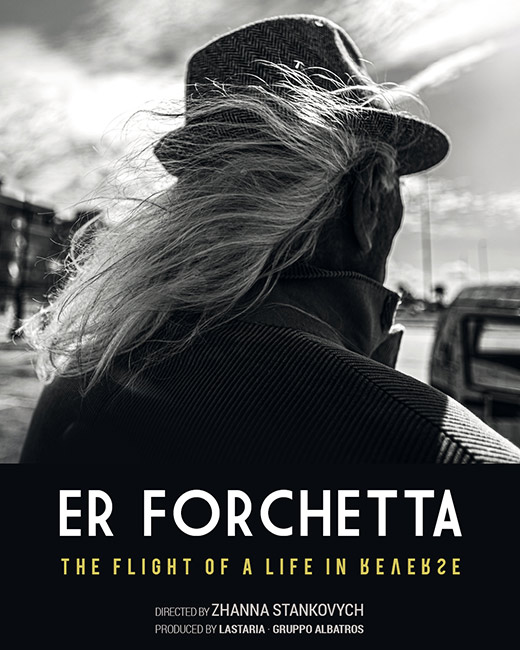
Sitting next to a stall of used books or behind the glass of a bus stop, with his long white hair and a bent fork pinned to his coat, he answers the phone with ease: «La Forchetta, good morning». They call him for a clearance job. He climbs into his van, lined with newspapers and magazines, and heads off to a new apartment to clear out.
For years, he opened the doors of other people’s homes with burglar’s tools. Today, he continues to open them for work. He doesn’t attach sentimental value to objects: raised in a poor, large family, he learned early on that things are meant for survival. They move, they’re sold, they constantly pass from hand to hand.
He resells the recovered items for very little money and splits the profit with his collaborators, keeping almost nothing for himself. In the world he has created, there is one ironclad rule: don’t steal.
He loves theater, writes scripts, and moves in Rome’s artistic circles. On the street, he acts and protects himself at the same time. Irony is his defense; dignity, his stance.
Piero is neither a symbol nor a social case. He is a free man who has lived two opposing lives and has chosen not to disappear.
Director’s Note
Not far from the spot in Ostia where Er Forchetta fell asleep for the last time in his van, I found a solitary wing half-buried in the sand. It was a fragment of wood shaped by the wind and the sea. In that image, I recognized the trajectory of Piero Patriarca: the flight of a life in reverse.
Our first meeting took place in front of the Garbatella metro station in Rome. He was sitting next to a used book stall, immersed in reading. I took a photograph from a distance, so as not to disturb that silent harmony. The next day I returned to meet him. I never imagined that encounter would change my path and give rise to this film.
Piero was a man outside the coordinates of ordinary social life. After prison, he had tried to reintegrate, without success. Instead of accepting that exclusion, he invented his own space: an association, a newspaper, a system of rules. He continued to open doors—the same gesture that had landed him in prison—but in a different way.
Perhaps it was a sort of symmetry between our lives that created an immediate connection. My own existence is also divided into two chapters: twenty-five years in Ukraine, twenty-five years in Rome. Reinventing oneself means crossing a divide and choosing not to remain trapped by it.
In that solitary figure, I glimpsed something profoundly Roman and, at the same time, universal—almost an echo of Pasolini: the last “Accattone” of a changing city.
There are a thousand ways to tell the story of a marginalized person’s struggle for survival. I decided to do so through poetry. Because poetry saved Piero, sustaining him through brutality and allowing him to glimpse light beyond hostility.
I chose black and white to best represent Piero’s life, which unfolded amid opposites: legality and illegality, light and shadow, harsh reality and poetry. The use of evocative photography, alternating with observational footage, allowed me to linger in his silences and to draw near without intruding.
This film stems from a gaze that lingered a moment longer than the others. It is an attempt to hold onto a presence before time erases it.
SOUNDTRACK
The film’s soundtrack was composed by director Zhanna Stankovych and was conceived as a musical tribute to that mysterious amber-hued season that precedes every winter: a suspended moment in time when light and shadow draw closer and contrasts become more subtle.
At the heart of this imagery lies the “disamara”, the maple seed that begins as a pair of mirror-image spirals, each of which, after separating, takes its own flight. This image that evokes the dual trajectory of Piero Patriarca’s life, suspended between two opposing existences.
CREDITS
Original title
Er Forchetta – Il volo di una vita al contrario
International title
Er Forchetta – The Flight of a Life in Reverse
Director
Zhanna Stankovych
Country
Italy
Year
2026
Running time
46’54’’
Original language
italian
Subtitles
English
Genre
documentary
Image format
black and white
Video format
digital / Full HD
Resolution
1920×1080
Aspect ratio
16:9 / 1.78:1
Sound
stereo
Production
Lastaria / Gruppo editoriale Albatros
Website
www.erforchetta.com
Copyright
© 2026 Lastaria / Gruppo editoriale Albatros
Written, directed and narrated by
Zhanna Stankovych
Cinematography
Zhanna Stankovych
Editing and post-production
Bernhard Gemassmer
Special advisor
Enrico Graziani
Original music
Zhanna Stankovych
Piano
Zhanna Stankovych
Violin
Oksana Tiutiunyk
Sound engineer
Nick Valente
English subtitles
Iris Gemassmer
Graphic and web design
Simone Zanco